
Jul 28, 2026 | by Home Fix Interiors
What Is the Difference Between an Interior Designer and an Interior Manufacturer?
When you start planning your home interiors, you will probably come across two terms quite often: interior designer and interior manufacturer.
At first, they may sound like the same thing. But they are not.
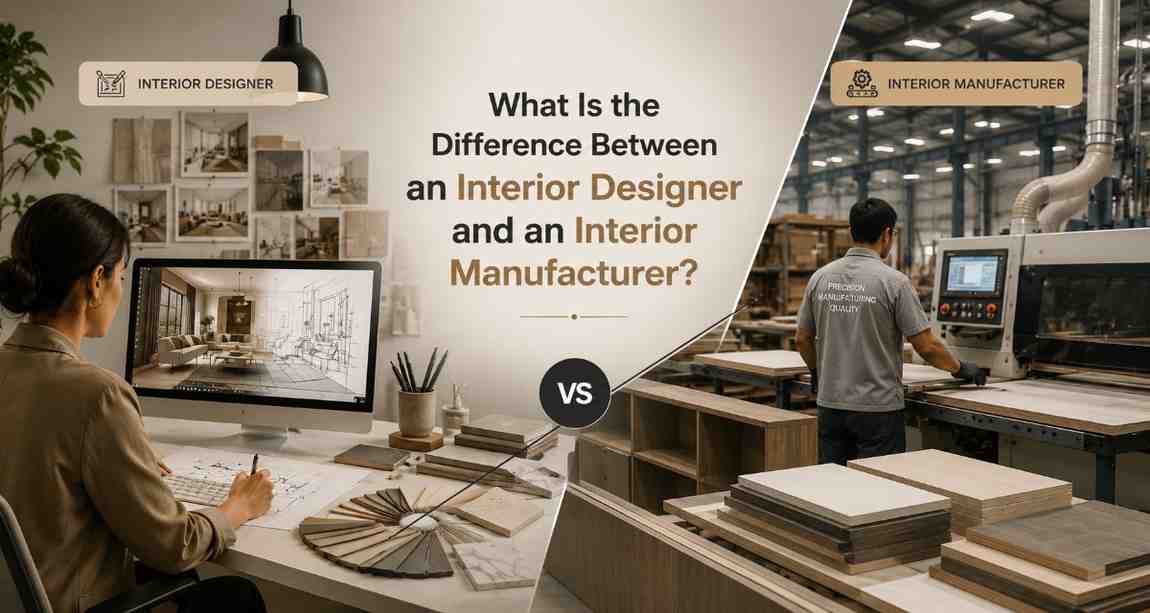
An interior designer mainly focuses on planning and designing your space. An interior manufacturer is involved in making the actual furniture and interior components.
Some companies only provide design services, while others handle both design and manufacturing under one roof.
What Does an Interior Designer Do?
An interior designer’s main job is to plan how your space should look and function.
For example, if you are building a new home, the designer may help you decide:
- Where the kitchen cabinets should go
- How much wardrobe storage you need
- Where to place the TV unit
- Which colours and finishes suit your home
- What type of furniture will work in each room
- How to make the available space more practical
They may also prepare floor plans, 3D designs, material selections and other drawings before the work begins.
In short, an interior designer turns your ideas into a proper interior plan.
But there is another important question:
Who is going to make everything shown in that design?
That’s where an interior manufacturer comes in.
What Is an Interior Manufacturer?
An interior manufacturer is involved in the actual production of furniture and interior components.
Instead of making everything at the customer’s home, the components are manufactured in a dedicated factory using machinery, tools and trained workers.
Depending on the company, manufacturing may include:
- Modular kitchens
- Wardrobes
- TV units
- Bedroom furniture
- Storage units
- Office furniture
- Custom sofas
- Other customised furniture
The process can involve cutting, drilling, edge banding, assembly, finishing and quality checking before the products reach the site.
So, an interior manufacturer is not only thinking about how the furniture should look. They are also responsible for how that furniture is made.
Why Does Factory Manufacturing Matter?
The way your furniture is manufactured can have a direct impact on the final result.
With factory-made interiors, the work is carried out in a controlled environment rather than doing every stage at the customer’s site.
This can offer several advantages.
Better Accuracy
Factory machinery can help achieve more consistent measurements and cleaner cuts.
This is particularly important for modular kitchens, wardrobes and other furniture where even a small measurement error can affect the final fit.
Consistent Finish
When multiple furniture pieces are part of the same project, getting a consistent finish is important.
Factory production makes it easier to follow the same process and maintain consistency across different components.
Quality Checking Before Installation
One of the useful advantages of factory manufacturing is that the components can be checked before they reach your home.
Instead of finding every issue during installation, the manufacturing team can inspect the furniture during production and assembly.
More Organised Installation
When components are manufactured and prepared before installation, the site work can be more organised.
The furniture arrives ready for the installation process rather than being built from scratch at the site.
What Should You Ask an Interior Company Before Choosing One?
An interior designer and an interior manufacturer have different roles, but both are important in a complete interior project.
The designer focuses on how your space should look and work.
The manufacturer focuses on how the furniture is produced and finished.
And when these two areas are handled together, the entire process can become easier to manage.
So, the next time you compare interior companies, don’t only ask about their designs.
Ask one more question:
“Where will my interiors actually be manufactured?”
The answer can tell you a lot about the company you are planning to work with.