


Mar 02, 2026 | by Home Fix Interiors
Factory-Made Interior Materials vs Traditional Method: What’s the Real Difference?
When planning home interiors, many houseowners face one common question:
Should you choose factory-made interiors or go with the traditional carpenter method?
Both approaches have their own advantages, but the difference in quality, precision, durability, and project timelines can be significant. Understanding these differences helps you make the right decision for your home and budget.
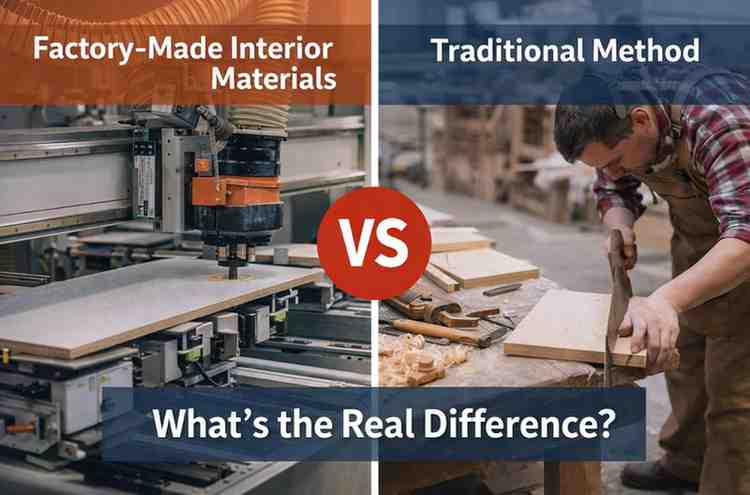
What Are Factory-Made Interiors?
Factory-made interiors are produced in a controlled factory using advanced machines and precision tools. Cabinets, wardrobes, and modular units are pre-designed, machine-cut, edge-banded, and assembled before they reach the site. Because everything is made inside a factory, the quality is more consistent and accurate.
For example; fully automatic edge banding machines make the edges smooth and properly sealed, so they are not too sharp and are safer compared to manual work. Every panel has uniform thickness, clean finishing, and perfect alignment.
Another big advantage is time-saving and continuity in quality. Since most of the work is completed in the factory, on-site installation becomes faster and more organised. Advanced machinery speeds up the process while maintaining the same high standard for every piece. It’s a perfect balance of human creativity and machine precision — delivering durable, neat, and beautifully finished interiors in less time.
What Is the Traditional Carpenter Method?
In the traditional method, furniture and interior components are built directly at your home by a carpenter. Materials are cut, assembled, and finished on-site, and the final outcome mostly depends on the carpenter’s skill and experience. This process usually takes more time because every step is done manually at the location. It also requires a highly experienced carpenter, as even a small mistake in measurement or cutting may lead to material damage and replacement.
Since the entire work happens at home, it involves more manpower and continuous activity until completion. The quality can vary based on the team and working conditions. While traditional work carries a personal, handcrafted touch, it needs patience, careful supervision, and the right expertise to achieve the desired result.
Key Differences Between Factory-Made Interiors and Traditional Method
Precision & Finishing
Machines ensure exact measurements, smooth edges, uniform finishing, and minimal errors.
Finishing depends on manual skill. Small measurement errors and uneven finishing can sometimes occur.
Material Quality & Processing
Materials are processed using automated cutting machines, edge banding technology, and pressure laminations. This increases durability and reduces damage.
Cutting and pasting are done manually. Moisture exposure during on-site work may affect materials.
Time & Project Completion
Most components are ready before installation. On-site work is faster and cleaner.
Work happens entirely at your home, which may take longer due to manual cutting, polishing, and finishing.
Dust & Site Disturbance
Minimal dust and noise at your home since most work is completed off-site.
Cutting, sanding, and polishing create dust and noise during execution.
Cost Comparison
Slightly higher initial cost due to machinery, branded materials, and structured processes.
May appear cheaper initially but can involve maintenance costs later.
Customization Flexibility
Offers modular customization with precise design planning.
Allows flexible design changes during execution but may affect finish quality.
Warranty & Accountability
Usually comes with structured warranty and organized service support.
Warranty depends on individual carpenter commitment.
Before deciding, compare long-term value rather than just initial cost. A well-planned interior should not only look beautiful but also perform well for many years.
Work With the Right Team
Collaborate with experienced professionals, deliver quality work, and shape a career built on skill, teamwork, and excellence.
